
Today, CUPE Nova Scotia School Board Council of Unions Chair Nelson Scott and Co-Chair Andrew Weaver visited the picket line of United Steelworkers in Amherst, where they are striking to gain improved wages and living standards from their employer, IMP Aerostructures. Scott and Weaver presented USW representatives with a donation from over 5,000 education workers across the province, to express their support. CUPE Nova Scotia will always stand in solidarity with workers in their fight for fairness and improved working conditions.
Safe Staff, Safe Schools: A worker-led review of violence in Nova Scotia’s public schools
For any school support staff who have not yet read our report, we urge every member to take a look at Safe Staff, Safe Schools: A worker-led review of violence in Nova Scotia’s public schools.
Violence in public school is at crisis level. The 2022-2023 school year saw 27,000 violent incidents in public schools across Nova Scotia. And we know that with barriers to reporting, a lack of support from management, and overworked staff, that number is likely even higher. If the last year saw similar numbers, increasing at a similar rate as the last few years, we can estimate well over 30,000 incidents in the 2023-24 year also.
Why did we write this report?
In 2022, we tried to sound the alarm to Minister of Education and Early Childhood Development Becky Druhan and Tim Houston’s PC government about the crisis of violence in our schools. We shared our concerns about the issue and offered detailed strategies to address it in our proposals. The employer was only willing to implement some of these strategies—meaning workers continue to deal with violence in the workplace.
We contacted the provincial government about this again in December 2023. We received no response. While they ignored us, the crisis of violence in public schools continues to get worse, and underfunding and understaffing has increased.
Now the Auditor General has produced a report echoing what we have been saying: violence in schools is increasing because students do not have the staff support that they need in the classroom.
Since the Department of Education and Early Childhood Development (EECD) wasn’t using the information we tried to share, we thought that Nova Scotians had a right to know what we were sending our kids into, just as this school year was about to start.
Public service workers are the public
Now that we’re bargaining, it’s essential that parents, families, and the school communities we serve understand that school support staff want to address understaffing, poor compensation in the sector, and the problems with reporting violent incidents because we want a safe workplace AND a safe learning environment for our kids. We are part of our school communities, and since we deal with violent incidents the most, we have a lot of information and insights to offer.
Our contribution to dialogue and decision-making on this topic should match up with our daily contribution to our schools.
We know that the issues that make our working lives more stressful, less healthy, and more challenging overall, are deeply connected to the issue of violence in public schools. We know how to improve our workplaces, both for staff and for students.
Our campaign is already working
The EECD recently invited CUPE, NSGEU, NSUPE, and SEIU to a meeting on this topic. It was a short meeting, and an incredibly overdue first step. But together, we moved our employer from completely ignoring our concerns, to an attempt at consultation. It’s not enough, but it’s enough to know the pressure we are putting on the EECD is making a difference.
What members can do to support bargaining and this campaign
Getting our employer to listen to our concerns takes more than just the bargaining committee. It takes all of us. Here are some actions you can take immediately:
READ THE REPORT
You know how bad this issue is in your school but read the report to see how fellow members are being impacted in other parts of the province, and to see the included recommendations.
SIGN THE PETITION
Go to cupe.ca/safe-schools to read more and sign the petition. Join hundreds across Nova Scotia who support workers in schools!
SHARE WITH YOUR COMMUNITY
Whether it’s a Facebook post, or a chat over the dinner table, please talk to your network about our campaign. This is a public issue, and we need public support.
Download images you can use on Facebook/Meta, Twitter/X and Instagram here.
COME TO YOUR LOCAL’S BARGAINING INFO SESSION AND PREPARE FOR A STRIKE VOTE
This week and next week, each local is holding information sessions. Contact your local executive to find out when yours is! Strike votes are taking place from October 1-9. A schedule will be released with times and locations for each local. It is crucial that all members participate in the vote to have their voices heard.
GET INVOLVED
Whether it’s taking the steps above, or reaching out to your local executive to find out how you can get more involved, any action helps.
Remember: This is your workplace, this is your contract, and this is your union.
Nelson Scott (Local 5050), Andrew Weaver (Local 964), Kevin Carther (Local 3876), Ciarán Llachlan Leavitt (Local 955), Jenny-Lynn Wardrope (Local 3890), Robert Amero (Local 2272), Jennifer Cox (Local 4682), and Shelley McNeil (Local 5047)
Nova Scotia School Board Council of Unions
Download a PDF version of this update here.
This is our contract, not our employer’s: We will maintain control of bargaining, we will remain united
As we shared in our last update, the employer is unwilling to meet us at a provincial table. Despite efforts to divide us, we are still coordinating bargaining. The NSSBCU will continue to be at each local’s table so that our common proposals can be negotiated in a way that is organized, coordinated, and united—this is our mandate.
Beyond that, it’s clear that if we give in and start to bargain provincial proposals separately, the employer will take full advantage of the separate tables and attempt to bargain inequality into our contracts. We know that the EECD is fine with major disparities between locals as we’ve spent the past year harmonizing wages across the province to address just that. This is a tactic to cultivate resentment and discontent amongst workers. Without coordinated bargaining, they will be able to go for the one item they can’t legislate or negotiate away: our solidarity.
They are already attempting to sow seeds of division by refusing to meet at a common table—another deliberate move—as it slows down bargaining by forcing us to talk about logistics, instead of proposals. Instead, they suggest amending certification orders so all school support staff would be bargaining as one local. Asking us to consider this lengthy and unnecessary process in the middle of bargaining just to be able to bargain provincial proposals at a common table, which is what we have done in the past, amounts to the EECD asking workers to jump through hoops just to enjoy our collective bargaining rights. They’re hoping to distract us—they won’t. They want us to lose steam—we won’t. They want to divide us—they can’t.
Common proposals don’t mean one-size-fits-all proposals
The only area in which this government is willing to engage a common front is regarding wages, as every local is getting the same response to our flat rate proposal: A no, and an offer of a general wage increase at a rate of 3%, 2% and 2% over three years.
This is important because a percentage increase means the increase amount is proportional to your existing wage. So, members with the lowest wage get smaller increases, folks with higher wages get bigger increases, and everyone’s increases will fall short of the growing cost of groceries, housing and other living expenses.
This one-size-fits-all approach means that after reporting a surplus of $143M for the last year, the provincial government wants to save money on the backs of the lowest earning workers in Nova Scotia. They want to say they are offering the same wage increases to everyone, but the bottom line is not the same when you’re starting with the lowest hourly wage.
This is another reason that having a common table is so important, as it will support us in ensuring that we win wage increases that will make a difference to all members. At the end of this update, we’ve included a breakdown of what the difference between a flat rate increase and percentage increase looks like for our highest and lowest paid members.
Maintain control, take action
The only way we could force the employer to a common table is if we spend time merging eight locals into one local, like they suggest. If they want to see 5,000 school support staff across Nova Scotia operate as one, let’s show them what that looks like.
Strike votes are taking place from October 1-9. A schedule will be released with times and locations for each local. We cannot emphasize enough that it is crucial that all members participate in the vote to have their voices heard. This doesn’t mean bargaining is over. There are still upcoming meetings set for bargaining and conciliation. However, we need to be prepared to take action. Again, the one thing they cannot take away from us at the table, or anywhere, is our solidarity.
We need to show the employer that we stand together, steadfast and united.
If you have any questions or concerns, we will be holding information sessions on bargaining and the outstanding issues between September 16-27. Again, each local will share information on the exact time and date of the sessions. The goal for these sessions is to make sure each and every member is informed about the bargaining process and prepared for the vote.
Nelson Scott (Local 5050), Andrew Weaver (Local 964), Kevin Carther (Local 3876), Ciarán Llachlan
Leavitt (Local 955), Jenny-Lynn Wardrope (Local 3890), Robert Amero (Local 2272), Jennifer Cox
(Local 4682), and Shelley McNeil (Local 5047)
Nova Scotia School Board Council of Unions
Download a PDF version of this update in English and French.
Demand Safety in Our Public Schools
There were 27,000 violent incidents in public schools in Nova Scotia in the 2022-23 school year. This a 60% increase over the past six years.
At the same rate, the number of violent incidents for the last school year can be estimated at over 30,000.
School support staff tried to sound the alarm and share their data on this issue with the provincial government in 2022. They didn’t engage with us. Two years, and an estimated 50,000 violent incidents later, front line workers are stepping up to demand the government finally take action to end violence in schools.
Join us in demanding the government keep students and staff safe in our public schools!
Read more and sign our petition: cupe.ca/safe-schools
Your NSSBCU
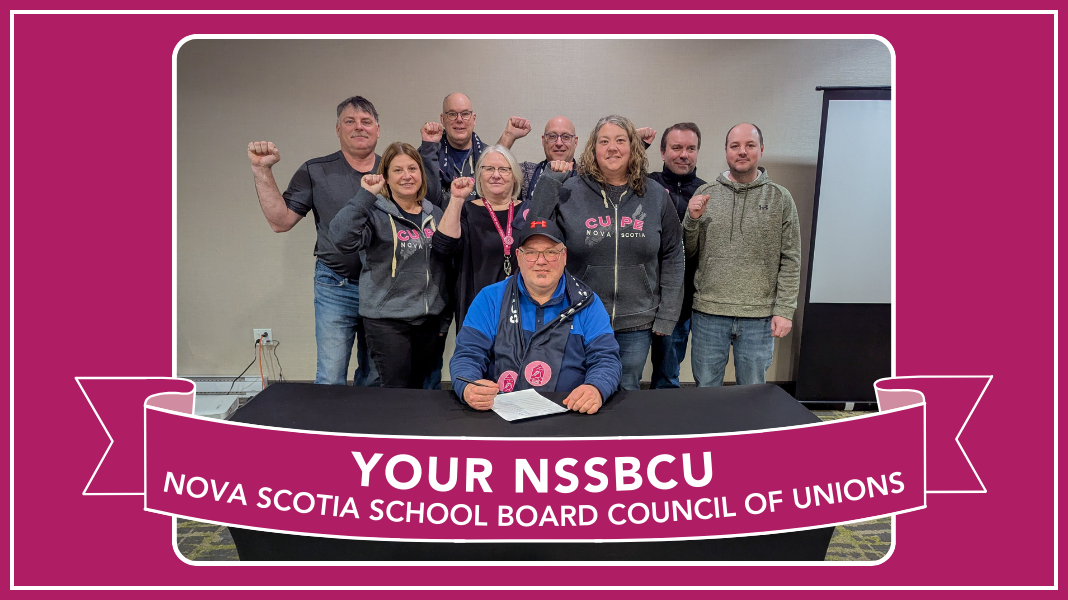
The Nova Scotia School Board Council of Unions (NSSBCU) includes the presidents of the eight CUPE locals representing school support staff in Nova Scotia. CUPE represents over 5,000 members working for all seven Regional Centres for Education and the Conseil scolaire acadien provincial, in every public school across the province.