
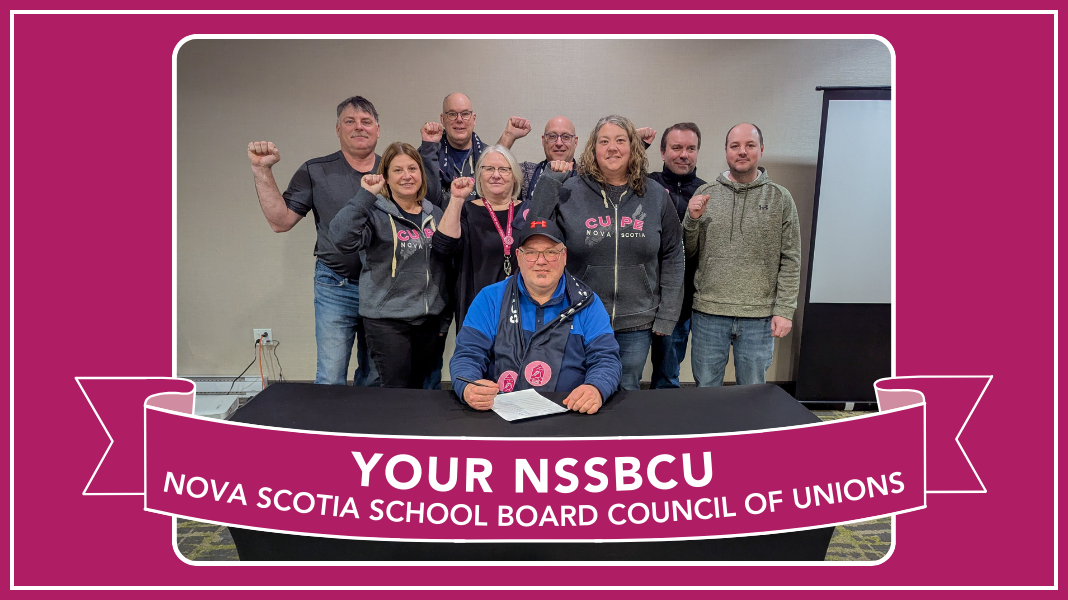
The Nova Scotia School Board Council of Unions (NSSBCU) includes the presidents of the eight CUPE locals representing school support staff in Nova Scotia. CUPE represents over 5,000 members working for all seven Regional Centres for Education and the Conseil scolaire acadien provincial, in every public school across the province.
School support staff: We have a contract!
The votes have been counted, and we have all agreed to ratify
Friends—we did it! The final votes have just been tallied up and school support staff across Nova Scotia have voted in favour of accepting the tentative agreement. We are proud of what we have achieved throughout this round of negotiations and honoured to have had the support of over 5,000 workers across Nova Scotia.
This round of bargaining really showed us what we can do when we work together. Unity in the Council and solidarity across all eight locals is what got us this deal. We did this together.
Together, we got a signed commitment from EECD Minister Brendan Maguire that school support staff will be part of discussions on safety in schools. We got paid training for all school support staff, not just classifications deemed “at risk”. Violent incident reports will now go to our union, as well as our employer.
Together, we got a flat rate wage increase that will bring our lowest-earning members closer to a decent wage.
Together we got improvements to leave benefits, pensions, and overtime provisions.
Together, we improved the lives of over 5,000 workers across Nova Scotia. Together we fought, and together we won!
We thank each and every member for your support, your action, and your solidarity.
Nelson Scott (Local 5050), Andrew Weaver (Local 964), Kevin Carther (Local 3876), Gerrard Matthews (Local 955), Jenny-Lynn Wardrope (Local 3890), Robert Amero (Local 2272), Jennifer Cox (Local 4682), Shelley McNeil (Local 5047), and Robert Mackay, Communications Officer
Nova Scotia School Board Council of Unions
Note: Former members of certain locals do need to claim retroactive wages with the employer. If you feel you are owed retropay, please reach out to the local executive to ensure you are aware of what steps you need to take to receive retroactive wages.
Last, best, final: School support staff have a deal!
We are so glad to share that we have reached a tentative agreement for CUPE school support staff across Nova Scotia! This is both at the common table and at all eight local tables!
These have been some long days on what has already been a long road—for all of us. But we came motivated, and we came prepared to accomplish a good deal for all 5,000 of us.
On Wednesday, all eight local presidents came together in Dartmouth for the second conciliation meeting for our common table negotiations. Nelson Scott, Chair of Council, along with our CUPE representatives, met with representatives of the EECD and our employers. Negotiations concluded around 2AM Thursday morning, continued throughout the day and again, went close to midnight, and then continued today.
There were some tense moments, tough conversations, and lots of talk about job action. But we were committed to achieving what members have said they need—and committed to solidarity amongst all school support staff.
It was all of us on Council sitting at a hotel conference room in Dartmouth late into the night, and it was all of us in every single public school in this province, wanting better for school support staff, and wanting more for Nova Scotia.
And together, we were able to find common ground with the employer and together negotiated a deal that we unanimously and enthusiastically recommend to our members. We know everyone will be anxious for the details, but please continue to be patient as more information is on its way along with plans for the ratification process. Please continue to check your emails for updates on your local ratification votes.
Chair of Council, Nelson Scott, and all members of Council would like to thank all parties involved for the time and effort that went into this round of bargaining. And of course, our thanks to our fellow members for your support, your dedication, and your solidarity!
Nelson Scott (Local 5050), Andrew Weaver (Local 964), Kevin Carther (Local 3876), Gerrard Matthews (Local 955), Jenny-Lynn Wardrope (Local 3890), Robert Amero (Local 2272), Jennifer Cox (Local 4682), Shelley McNeil (Local 5047) and Robert Mackay, Communications Officer
Nova Scotia School Board Council of Unions
Bargaining update for school support staff
Thank you to everyone for your ongoing support and commitment. As we shared last week, Chair of Council and President of Local 5050, Nelson Scott, along with our national representatives, met with the employer on Monday, February 10.
We had meaningful discussion and scheduled the next conciliation meeting for common table negotiations which will take place on Wednesday, February 26th.
Please stay tuned for further updates on local and common table negotiations that week.
Nelson Scott (Local 5050), Andrew Weaver (Local 964), Kevin Carther (Local 3876),
Gerrard Matthews (Local 955), Jenny-Lynn Wardrope (Local 3890), Robert Amero (Local 2272),
Jennifer Cox (Local 4682), and Shelley McNeil (Local 5047)
Nova Scotia School Board Council of Unions
Common table update: Little common ground, but we’re staying firm!
Yesterday, we attended the first common table bargaining meeting with our employer. There were representatives from each of the RCEs and CSAP, as well as the EECD.
We fought for this table, and we went into yesterday’s meeting ready to fight for a good deal. The truth is, we didn’t expect to reach an agreement in one day. But we did hope that after finally meeting at a common table we’d be able to make progress.
But as we’ve experienced before, our employer’s proposals indicate that they do not respect school support staff. They won’t give us what we deserve. We need to demand it.
So, where did we leave things yesterday?
We’re asking for improved reporting mechanisms for violent incidents, including reports being shared with our union. After fighting for years for the employer to take any action on the crisis of violence in our schools, they now insist sharing these occupational health and safety reports with our union is a violation of confidentiality. This is a blatant attempt to prevent school support staff from getting support from our union.
Regarding wages, the employer’s latest offer is a two-year deal with the following general economic increases:
- A 3% adjustment on April 1, 2024
- A 2% adjustment on April 1, 2025, with a 2.5% special adjustment on March 31, 2025
We did the math and worked out what this would mean for each wage rate in our sector. We want every single member to know how these proposals will impact them. We’re at the table, but the deal we’re fighting for belongs to all of us. Please see the table below.
What’s next?
Though the employer continues to disappoint us at the table, we are not backing down. We’re strong, we’re united and we’re here for all 5,000 of us.
On Monday our national representatives, along with Nelson Scott, Chair of Council, will meet with the employer to reaffirm our demands before the next bargaining date is scheduled. Please stay tuned for further updates.
A reminder that the public action planned in Halifax for tomorrow, February 8th has been postponed (along with the action outside EECD Minister Brendan Maguire’s office). Further details to follow. Any questions, please reach out to your local executive.
Nelson Scott (Local 5050), Andrew Weaver (Local 964), Kevin Carther (Local 3876), Gerrard Matthews (Local 955), Jenny-Lynn Wardrope (Local 3890), Robert Amero (Local 2272), Jennifer Cox (Local 4682), and Shelley McNeil (Local 5047)
Nova Scotia School Board Council of Unions
We’ll bargain together, and we’ll win together: EECD agrees to a common table for provincial proposals
Hello fellow school support staff, coworkers, friends, we have exciting news! After refusing to meet us at a common table for almost a year, the Department of Education and Early Childhood Development has agreed to meet the presidents of all CUPE eight locals representing school support staff at one common table to negotiate provincial proposals.
Thanks to the support and effort of all of our members, we have received a written commitment (via email) today to meet at a common table within ten days.
This is a victory—this is your victory!
As you know, the EECD had previously given the seven RCEs and CSAP a specific mandate that prevented any movement on wages at our local bargaining tables. They insisted we negotiate common items at local tables and then prevented employer representatives from actually negotiating. They wasted our time.
The only reason we have gone from a flat-out refusal to have a common table to a commitment to meet at a common table is our collective power. We put pressure on the employer, and it worked! This shows us what we can achieve when we act together.
Why were we pushing for this?
What we’ve been referring to as “common” or “provincial” proposals on issues that will be on the table for every local. Where one local might need to negotiate terms of a specific issue that only impacts their members, items like wages and workplace violence impact all of us. That’s why our strategy as union members has been to negotiate these issues together. If we all bargain those issues at the same time, it prevents the employer from being able to get one local to agree to a smaller wage increase, or less adequate health and safety language, for example. This is how we prevent the employer from employing a “divide and conquer” approach.
For the same reason that we as union members collective bargain one contract for all workers in one workplace, our eight locals will collectively bargain these common items together. That reason is that we are stronger together.
What are our provincial proposals?
You have told us that wages and workplace violence are major priorities for you, and we fought for those to be included. The EECD has agreed to discuss four items at a common table: (1) wages, (2) term, (3) job classification committee and reclassification, and (4) violence in the workplace.
In the meantime, the action outside EECD Minister Brendan Maguire’s office planned for tomorrow is cancelled. We don’t need to go to the Minister now that the EECD is coming to us!
The action planned for February 8th is also postponed.
Any questions, please reach out to your local executive. Please watch out for more updates soon.
Nelson Scott (Local 5050), Andrew Weaver (Local 964), Kevin Carther (Local 3876), Gerrard Matthews (Local 955), Jenny-Lynn Wardrope (Local 3890), Robert Amero (Local 2272), Jennifer Cox (Local 4682), and Shelley McNeil (Local 5047)
Nova Scotia School Board Council of Unions
Bargaining during an election
To our fellow CUPE school support staff in Nova Scotia: We know folks have been looking for an update on the progress of bargaining after we announced our strong strike mandate in October.
As you all know, Premier Tim Houston called a provincial election just days after that announcement. A few days later, we were informed by the HRCE and the SRCE that the Department of Education and Early Childhood Development ordered all bargaining dates scheduled before the election to be cancelled. Please see our public statement on bargaining being cancelled here.
What’s next?
At this point, almost all our eight locals have filed for conciliation. No conciliation meeting dates have been scheduled before the election either, but you can see the list of scheduled dates below.
- Local 964 – December 3
- Local 4682 – December 11
- Local 5047 – December 13
- Local 5050 – December 17
- Local 3890 – January 7 & 8
- Local 955 – January 15
- Local 2272 – January 16 & 17
We anticipate that progress in conciliation may take more than one meeting, so if your local is listed above, please watch out for an interim update from your local executive following the initial conciliation meeting, and an update from the Council before the holidays. As we confirm other meeting dates, we will provide further updates for those locals.
Getting our message out to the public
This past weekend we recorded interviews and testimonials with members speaking about the challenges we face every day at work.
Thanks to all who made the journey to the CUPE office in Dartmouth on Saturday to participate!
If you are interested in taking part in activities like this in the future, please let us know (and we hope you enjoy the behind-the-scenes photos)!
We want to ensure that the impact of poverty wages and burnout on school support staff remains top of mind as we head into the holiday season, so please continue to share the campaign page with your networks: cupe.ca/safeschools!
Just a few months after launching our Safe Staff, Safe Schools report and associated campaign, thousands of people across Nova Scotia have now visited the campaign page and sent a letter endorsing our recommendations to their elected representatives.
As always, please reach out with any questions you may have!
Nelson Scott (Local 5050), Andrew Weaver (Local 964), Kevin Carther (Local 3876), Ciarán Llachlan Leavitt (Local 955), Jenny-Lynn Wardrope (Local 3890), Robert Amero (Local 2272), Jennifer Cox (Local 4682), and Shelley McNeil (Local 5047)
Nova Scotia School Board Council of Unions
Download a PDF version of this update here.
Why I will strike again: A message from Nova Scotia’s school support staff
***Op-ed originally published in The Chronicle Herald on Friday, November 15, 2024***
Once upon a time, in the not-so-distant past for Nova Scotia, the best education a person could hope for was learning to read and learning basic arithmetic in a one-room schoolhouse, with kids of all ages and learning levels and one (probably overworked) teacher.
But that’s not the reality we live in anymore. As the physical space of schools have expanded, so has the team that ensures a healthy and successful learning environment. Nowadays, pretty much anyone you know who completed their primary and secondary education in Nova Scotia’s public schools would have done so in a building with hundreds (or thousands) of students, and hundreds of workers who educate, support and care for our kids.
Picture that one-room schoolhouse in your mind. Now imagine it expanding. With every new classroom, with library, computer lab, and specialized space, come more staff. As our communities grow, so do the needs of our communities. In 2024, school can mean an entire ecosystem that includes bringing kids to school and safely home every day, providing their breakfast and ensuring a safe and hygienic learning environment. It means childcare, it means supporting healthy personal development, and it means inspiring an entire generation.
Personally, I am a Child and Youth Care Practitioner. I have been for six years. Like anyone else, there are a few reasons I decided to go into this line of work. But mainly, I love working with kids, and I believe in the impact that this work can have in supporting and improving the physical, emotional, intellectual and social development of vulnerable children, youth and families. I believe that learning is more than just a classroom, desks, and a teacher.
I also believe that any ecosystem is as healthy as its’ members. School support staff are part of education ecosystems, and the treatment of the workers in these roles has a direct and tangible impact of the quality of our public education.
When kids witness violent incidents (like school support staff being punched, kicked, or held down and repeatedly bitten) it has an impact on them. When kids experience a high turnover of burnt-out staff, it has an impact on them. When bus routes are cancelled, it has an impact on them—and their parents. I know what you’re thinking: Job action impacts kids and parents also.
But I ask you, which would you choose: Supporting workers now, to ensure a safer, healthier, and more effective learning environment for kids in the future or opposing job action to keep kids in schools, knowing the standard of public education declines every year because the Department of Education chooses to ignore the pleas of workers who want to ensure our education ecosystems are thriving and that our kids are safe.
The government continue to sideline the workers that experience the ongoing crisis of violence in our schools the most. Though we have been pushing for action on that front for years, they will not include us the conversation when they design plans and policies to address the crisis. Maybe that’s why their moves seem so short-sighted. In July, it was three new schools in the HRM. Except by the time they are built, needs will have outpaced those new schools, and we will already need more. The 47 new staff positions promised a few weeks ago would not make a meaningful difference spread across the 142 schools in the HRCE, never mind the whole province.
But if your choice is still the latter option, I don’t blame you. I am a parent also, and I know how difficult it can be to find transportation or childcare alternatives when schools close for weather, professional development, or job action by educators.
In the Halifax Regional Municipality especially, it probably seems like just yesterday that CUPE 5047, representing school support staff at the Halifax Regional Centre for Education, were on strike. Even for us CUPE members, the possibility of job action again means a lot of planning and preparation to ensure we can continue to take care of our families and put food on the table. We have to make a difficult short-term decision in the name of a longer-term vision.
Over 5,000 school support staff across Nova Scotia believe in that vision and have made that hard decision. All we need now is your support. For the sake of our kids, our public education system, and our future, please stand with us.
Shelley McNeil
CUPE 5047 President
CUPE Nova Scotia School Board Council of Unions supports striking United Steelworkers
Today, CUPE Nova Scotia School Board Council of Unions Chair Nelson Scott and Co-Chair Andrew Weaver visited the picket line of United Steelworkers in Amherst, where they are striking to gain improved wages and living standards from their employer, IMP Aerostructures. Scott and Weaver presented USW representatives with a donation from over 5,000 education workers across the province, to express their support. CUPE Nova Scotia will always stand in solidarity with workers in their fight for fairness and improved working conditions.
Safe Staff, Safe Schools: A worker-led review of violence in Nova Scotia’s public schools
For any school support staff who have not yet read our report, we urge every member to take a look at Safe Staff, Safe Schools: A worker-led review of violence in Nova Scotia’s public schools.
Violence in public school is at crisis level. The 2022-2023 school year saw 27,000 violent incidents in public schools across Nova Scotia. And we know that with barriers to reporting, a lack of support from management, and overworked staff, that number is likely even higher. If the last year saw similar numbers, increasing at a similar rate as the last few years, we can estimate well over 30,000 incidents in the 2023-24 year also.
Why did we write this report?
In 2022, we tried to sound the alarm to Minister of Education and Early Childhood Development Becky Druhan and Tim Houston’s PC government about the crisis of violence in our schools. We shared our concerns about the issue and offered detailed strategies to address it in our proposals. The employer was only willing to implement some of these strategies—meaning workers continue to deal with violence in the workplace.
We contacted the provincial government about this again in December 2023. We received no response. While they ignored us, the crisis of violence in public schools continues to get worse, and underfunding and understaffing has increased.
Now the Auditor General has produced a report echoing what we have been saying: violence in schools is increasing because students do not have the staff support that they need in the classroom.
Since the Department of Education and Early Childhood Development (EECD) wasn’t using the information we tried to share, we thought that Nova Scotians had a right to know what we were sending our kids into, just as this school year was about to start.
Public service workers are the public
Now that we’re bargaining, it’s essential that parents, families, and the school communities we serve understand that school support staff want to address understaffing, poor compensation in the sector, and the problems with reporting violent incidents because we want a safe workplace AND a safe learning environment for our kids. We are part of our school communities, and since we deal with violent incidents the most, we have a lot of information and insights to offer.
Our contribution to dialogue and decision-making on this topic should match up with our daily contribution to our schools.
We know that the issues that make our working lives more stressful, less healthy, and more challenging overall, are deeply connected to the issue of violence in public schools. We know how to improve our workplaces, both for staff and for students.
Our campaign is already working
The EECD recently invited CUPE, NSGEU, NSUPE, and SEIU to a meeting on this topic. It was a short meeting, and an incredibly overdue first step. But together, we moved our employer from completely ignoring our concerns, to an attempt at consultation. It’s not enough, but it’s enough to know the pressure we are putting on the EECD is making a difference.
What members can do to support bargaining and this campaign
Getting our employer to listen to our concerns takes more than just the bargaining committee. It takes all of us. Here are some actions you can take immediately:
READ THE REPORT
You know how bad this issue is in your school but read the report to see how fellow members are being impacted in other parts of the province, and to see the included recommendations.
SIGN THE PETITION
Go to cupe.ca/safe-schools to read more and sign the petition. Join hundreds across Nova Scotia who support workers in schools!
SHARE WITH YOUR COMMUNITY
Whether it’s a Facebook post, or a chat over the dinner table, please talk to your network about our campaign. This is a public issue, and we need public support.
Download images you can use on Facebook/Meta, Twitter/X and Instagram here.
COME TO YOUR LOCAL’S BARGAINING INFO SESSION AND PREPARE FOR A STRIKE VOTE
This week and next week, each local is holding information sessions. Contact your local executive to find out when yours is! Strike votes are taking place from October 1-9. A schedule will be released with times and locations for each local. It is crucial that all members participate in the vote to have their voices heard.
GET INVOLVED
Whether it’s taking the steps above, or reaching out to your local executive to find out how you can get more involved, any action helps.
Remember: This is your workplace, this is your contract, and this is your union.
Nelson Scott (Local 5050), Andrew Weaver (Local 964), Kevin Carther (Local 3876), Ciarán Llachlan Leavitt (Local 955), Jenny-Lynn Wardrope (Local 3890), Robert Amero (Local 2272), Jennifer Cox (Local 4682), and Shelley McNeil (Local 5047)
Nova Scotia School Board Council of Unions
Download a PDF version of this update here.
This is our contract, not our employer’s: We will maintain control of bargaining, we will remain united
As we shared in our last update, the employer is unwilling to meet us at a provincial table. Despite efforts to divide us, we are still coordinating bargaining. The NSSBCU will continue to be at each local’s table so that our common proposals can be negotiated in a way that is organized, coordinated, and united—this is our mandate.
Beyond that, it’s clear that if we give in and start to bargain provincial proposals separately, the employer will take full advantage of the separate tables and attempt to bargain inequality into our contracts. We know that the EECD is fine with major disparities between locals as we’ve spent the past year harmonizing wages across the province to address just that. This is a tactic to cultivate resentment and discontent amongst workers. Without coordinated bargaining, they will be able to go for the one item they can’t legislate or negotiate away: our solidarity.
They are already attempting to sow seeds of division by refusing to meet at a common table—another deliberate move—as it slows down bargaining by forcing us to talk about logistics, instead of proposals. Instead, they suggest amending certification orders so all school support staff would be bargaining as one local. Asking us to consider this lengthy and unnecessary process in the middle of bargaining just to be able to bargain provincial proposals at a common table, which is what we have done in the past, amounts to the EECD asking workers to jump through hoops just to enjoy our collective bargaining rights. They’re hoping to distract us—they won’t. They want us to lose steam—we won’t. They want to divide us—they can’t.
Common proposals don’t mean one-size-fits-all proposals
The only area in which this government is willing to engage a common front is regarding wages, as every local is getting the same response to our flat rate proposal: A no, and an offer of a general wage increase at a rate of 3%, 2% and 2% over three years.
This is important because a percentage increase means the increase amount is proportional to your existing wage. So, members with the lowest wage get smaller increases, folks with higher wages get bigger increases, and everyone’s increases will fall short of the growing cost of groceries, housing and other living expenses.
This one-size-fits-all approach means that after reporting a surplus of $143M for the last year, the provincial government wants to save money on the backs of the lowest earning workers in Nova Scotia. They want to say they are offering the same wage increases to everyone, but the bottom line is not the same when you’re starting with the lowest hourly wage.
This is another reason that having a common table is so important, as it will support us in ensuring that we win wage increases that will make a difference to all members. At the end of this update, we’ve included a breakdown of what the difference between a flat rate increase and percentage increase looks like for our highest and lowest paid members.
Maintain control, take action
The only way we could force the employer to a common table is if we spend time merging eight locals into one local, like they suggest. If they want to see 5,000 school support staff across Nova Scotia operate as one, let’s show them what that looks like.
Strike votes are taking place from October 1-9. A schedule will be released with times and locations for each local. We cannot emphasize enough that it is crucial that all members participate in the vote to have their voices heard. This doesn’t mean bargaining is over. There are still upcoming meetings set for bargaining and conciliation. However, we need to be prepared to take action. Again, the one thing they cannot take away from us at the table, or anywhere, is our solidarity.
We need to show the employer that we stand together, steadfast and united.
If you have any questions or concerns, we will be holding information sessions on bargaining and the outstanding issues between September 16-27. Again, each local will share information on the exact time and date of the sessions. The goal for these sessions is to make sure each and every member is informed about the bargaining process and prepared for the vote.
Nelson Scott (Local 5050), Andrew Weaver (Local 964), Kevin Carther (Local 3876), Ciarán Llachlan
Leavitt (Local 955), Jenny-Lynn Wardrope (Local 3890), Robert Amero (Local 2272), Jennifer Cox
(Local 4682), and Shelley McNeil (Local 5047)
Nova Scotia School Board Council of Unions
Download a PDF version of this update in English and French.